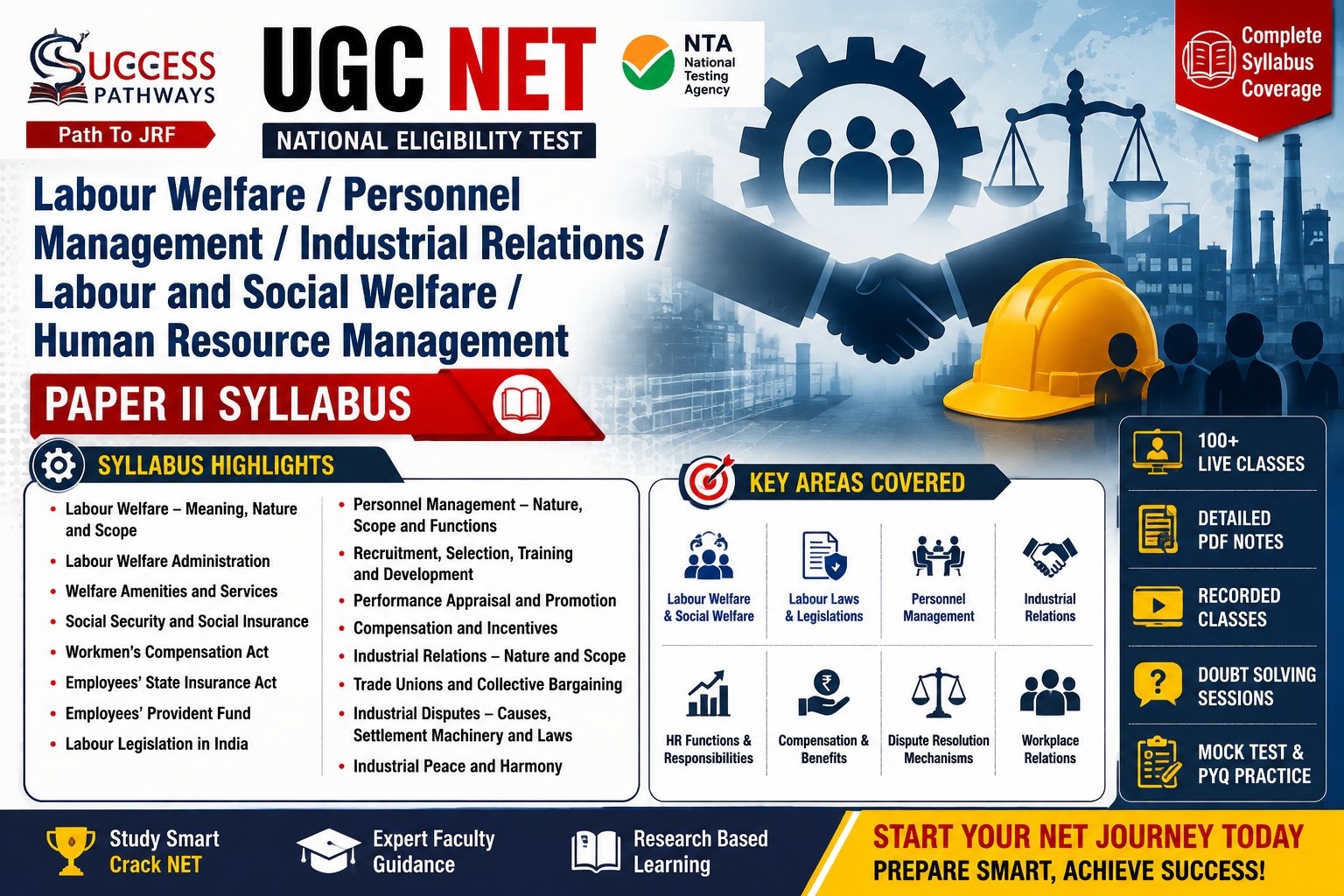
Subject: Labour Welfare/Personnel Management/Industrial Relations/ Labour and Social Welfare/Human Resource Management PAPER II SYLLABUS
Unit - I
Principles and Practices of Management:
- Development of management Thought, Contributions of Taylor, Fayol, Mayo, Mary Parker Follett and C.I. Barnard.
- Behavioural Approach, Systems Approach, Quantitative Approach and Contingency Approach.
Function of Management:
- Planning and Decision Making, Organising, Staffing, Directing, Controlling, Coordinating.
Unit - II
Human Resource Management:
- Conceptual framework, Human Resource Planning, Job Analysis, Recruitment, Selection, Placement, Induction, Training and Development, Performance Management, Job Evaluation, Compensation Management, Employee Benefits and Incentives, Managing Career.
New Trends in HRM:
- Changing environment of HRM and contemporary challenges, Emerging HRM Concepts.
Unit - III
Human Resource Development (HRD):
- Concepts, Assumptions, Values, HRD Mechanisms, Action – research Model, HRD Culture and Climate, HRD Interventions, HR Accounting and Audit, Consultant – client relationship, Knowledge Management, Human Resource Information System.
International Human Resource Management (IHRM):
- Organisational context of IHRM, IHRM and Sustainable Business, Functions of IHRM, Cross – Cultural Studies, Cultural Diversity, Transnational Organisations, IHRM models.
Unit - IV
Organisational Behaviour:
- Concept, Scope, Nature of human behavior, Personality, Perception, Learning, Attitude, Motivation, Interpersonal Behaviour, Group Dynamics, Leadership, Communication, Power and Authority, Stress, Organisational Change and Development.
Unit - V
Industrial Relations:
- Concept, Scope, Evolution, Approaches, Actors and Models, Conflict and cooperation, Bi-partitism, Tri-partitism, Collective Bargaining, Workers’ Participation in Management, Grievance Handling and Disciplinary Action, Code of Conduct, Industrial Relations in changing scenario, Employers’ organisations.
Trade Unions:
- Concepts, Evolution, Problems of trade unions in India, Recognition, The Trade Unions Act, 1926. Emerging role of trade unions in India.
Unit - VI
Industrial Disputes:
- Factors, Forms, Trends, Prevention and Settlement, Role of State and Central Labour Administration, Strikes and Lockouts. The Industrial Employment (Standing Orders) Act, 1946. The Industrial Disputes Act, 1947.
Unit - VII
Labour Legislation:
Objectives, Principles, Classification and Evolution. International Labour Organisation, Social Justice and Labour Legislation, Indian Constitution and Labour Laws. The Factories Act, 1948.
- The Mines Act, 1952.
- The Inter-state Migrant Workmen (Regulation of employment and conditions of service) Act, 1979.
- The Contract Labour (Regulation and Abolition) Act, 1970.
- The Building and other Construction workers (Regulation of employment and conditions of service) Act, 1996.
- The Child Labour (Prohibition and Regulation) Act, 1986.
Unit - VIII
Wages:
Concept, Types, Factors influencing wages, Wage Theories and Wage Differentials
- The Minimum Wages Act, 1948.
- The Payment of Wages Act, 1936.
- The Payment of Bonus Act, 1965.
- The Equal Remuneration Act, 1976.
- The Payment of Gratuity Act, 1972.
- The Employees’ Provident Fund and Miscellaneous Provisions Act, 1952.
Unit - IX
- Labour Welfare: Concept, Scope, Types, Theories and Principles, Industrial Health and Hygiene, Industrial Accidents and safety, Occupational Diseases
- Social Security: Concept and Scope, Social Assistance and Social assurance. Labour Market:
Unit - X
- Features, Demand and Supply of Labour, Nature and Composition of Indian Labour Force, Unemployment and Underemployment, Types of Labour Market,
- Characteristics of Indian Labour Market, New Dynamics of Labour Market in India, Economic Systems and Labor Market, Problems of Labour in India.

.png)